

Wonderbringers Newsletter with Monica Parker

View this email in your browser

Hello Wonderseekers,
I visited the Lee Miller exhibition at the Tate Modern this weekend, and it was so moving that afterwards I felt inspired to watch the film about her life, Lee (starring Kate Winslet in an unsurprisingly incredible performance). Miller was a pioneering photographer who cut her chops as a Vogue model and then became the lover, collaborator, and muse of avant-garde artist Man Ray, before ending her photography career as a photojournalist embedded with troops in Europe during World War 2.
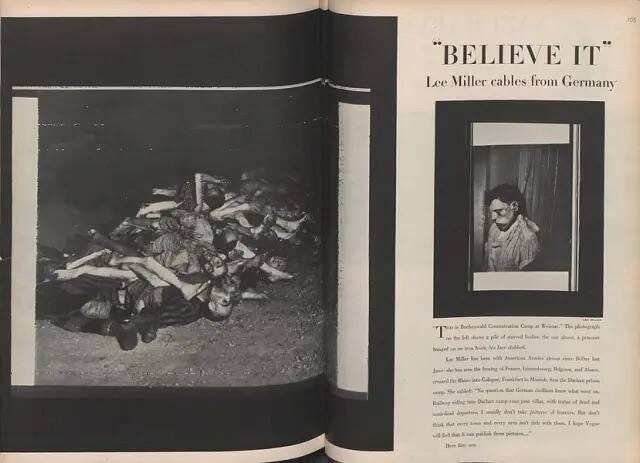
On April 30, 1945, a day after the liberation of Dachau, Miller was one of the first correspondents to capture the depravity of the death camps on film, and her photos are harrowing. But before the pictures were even published, a narrative was already being spun by the Nazis that the camps were no more than Allied propaganda. Devastated by what she documented and adamant that it be shared, Miller sent an urgent cable to her British Vogue editor, desperation screaming down the last line of the telegram: ‘I IMPLORE YOU TO BELIEVE THIS IS TRUE’.
Although British Vogue was not allowed to publish the full selection of photos (they were deemed too damaging to the morale of the British war-weary), American Vogue ran them all. The title of the article was ‘Believe It’.
The expression ‘seeing is believing’ is a bit of a misnomer, because what we see and what we believe can be two very different things. My experience investigating death row crimes taught me that eyewitness testimony is notoriously unreliable and even more notoriously malleable. But it's not just the chaotic intensity of a crime scene where our eyes deceive us. A famous psychological experiment asks participants to watch a video of a basketball game and count how many times the ball is passed. During the game, a person in a gorilla suit casually saunters past. Only 50% of viewers even notice the gorilla, as they are too focused on counting the passes.
Lee Miller’s story reminds us that as long as there have been horrors, there have been narratives crafted to shape what we believe about them. And these narratives are enabled by our brains, which override our senses when there is sufficient motivation. As a society, we don’t need to agree on everything, but without a shared reality, we cease to function. Even the simplest of agreements becomes impossible if you think the other side is hallucinating.
So if you saw the murder of Renee Good in Minneapolis at the hands of an ICE agent and are aghast that other people can deny something so clearly documented, be assured you are not the first (nor the last) to know the shock of objective truth being traded for a beguiling narrative. The always brilliant Tressie McMillan Cottom describes this feeling as being ‘a necessary part of developing your political imagination’, meaning it expands our awareness that even something as primary as our senses can be twisted in the hands of skilled manipulators.
But this shaping of the narrative is longitudinal and subtle, not just the blunt instrument of calling SUV-driving moms terrorists. In 1922, journalist and media theorist Walter Lippmann wrote about the discrepancy between ‘the world outside and the pictures in our heads,’ arguing that people consume so much media that shapes their worldview (whether that be movies, books, newspapers, etc.) that they already have predetermined narratives to match the world they encounter. So when someone rejects what they see, it is less cognitive dissonance and more a form of dissociation or ‘moral disengagement’, where they’re not seeing reality; rather, a narrative aligned with their identity rolls before their eyes instead. And it should go without saying that this can apply to people across all political persuasions.
So how do we keep ourselves from trading objectivity for a more comforting subjective narrative? And what can we do in a world where we are asked to deny what we know to be objectively true?
We don’t waste our breath trying to convince the blind to open their eyes. It’s taken years of influence to generate these ‘pictures in their heads’. A well-formed riposte from a member of an outgroup will not be the Damascene conversion that causes the scales to fall from their eyes. We also don’t throw up our hands and say all hope is lost, quoting Orwellian aphorisms with wry know-it-all cynicism. Pessimism is one luxury we can’t afford.
According to professionals, one action is paramount. We must create communities of shared reality. Societies survive manipulation by cultivating and protecting spaces where people can confidently say, ‘we know what we saw’ and have that confirmed, not out of shared identity but because the objective facts withstand scrutiny. These communities become the repositories of our shared reality when official narratives seek to blind us.
I strive to be apolitical in Wonderbringers, but I will not allow the narrative to equate neutrality with moral disengagement. Creating communities of shared reality is a moral imperative. Please know this newsletter can be one of yours. Where we stand witness and say with our full throat and to anyone who is within earshot, ‘Believe it’.
Some wonderbringers for me this week:
Human memory is perfectly imperfect: Some of its apparent flaws may be features, not bugs.
Déjà vu: The eerie sensation is the shadow of your mind searching inward for clues to its own survival.
The neuroscience of reality: Reality is constructed by the brain, and no two brains are exactly alike.
I’m working on increasing this community in 2026. If you find value in Wonderbringers and know someone else who might too, they can sign up here.
With wonder,

Follow Me


Why am I getting this email?
Good question!
You’re getting this email because you are on HATCH Analytics’s or Monica Parker’s mailing list.
If you don’t want to receive these emails, you can unsubscribe at the bottom.
(We do hope you stick around, though.)
Copyright ©*|CURRENT_YEAR|* Monica C. Parker. All rights reserved.
Want to unsubscribe? That’s ok! We’re sad to see you go, but you’ll still be a part of our Wonderbringer community in spirit.
Mailing address:
10 Colosseum Terrace
London, UK NW1 4EB