

Wonderbringers Newsletter with Monica Parker

View this email in your browser
Hello wonderseekers!
I was out at dinner with some of my favourite people the other night, and the conversation took a turn towards the topic of hope and how our moms raised us with unbridled optimism.
I’ve mentioned before that I grew up in a home where my mom espoused the power of positive thinking. Any negative thought I dared to express was met with a fervent, ‘no neggies!’ or a more direct, ‘cancel, cancel, cancel.’ (The latter would most closely resemble the thrice-spitting custom of Mediterranean grannies when warding off the evil eye.) I bristled against it at the time, but I recognise now that the research is very clear—seeing the positive in life is good for us emotionally and physically.
Positive emotions are beneficial in helping us ‘broaden and build’ our social and emotional competencies and are key contributors to long-term learning. But it’s important to also recognise that toxic positivity can take us into an extreme realm where positivity loses its benefits. When we force all negativity from our mind, we don’t allow ourselves the emotional granularity required for longitudinal resilience. Negative emotions exist for a reason, and denying them their place in our life is also not healthy.
Of the top five positive emotions (happiness, gratitude, love, contentment, hope), two of them can actually be considered mixed emotions, and those are particularly good for us. Why is that? When we experience a mixed emotion, as opposed to a purely positive (or negative) one, we give our brain the opportunity to marinate in the grey area and nuance that mixed emotions represent. And living in that grey area allows us to have greater emotional buoyancy while also combating the scourge of polarisation.
Gratitude is a mixed emotion because feeling grateful for what we have naturally includes a reflection on what others don't have. In that comparison, we find humility and a sense of small self, where the world feels bigger and we feel smaller. That is wonder. I argue hope is the same sort of mixed emotion. Feeling true hope, as opposed to a toxic positivity, ‘happy-chondriac’ variety hope, means confronting, not avoiding, the reality of darkness and making a conscious choice to bravely seek the light, even when, frankly, it feels kinda sucky to do so.
Consider Little Orphan Annie’s ditty ‘the sun’ll come out tomorrow.’ Without the clouds, why would we hope for the sun or appreciate it nearly as much? (And it only occurs to me now that we went to see that musical every freaking year it was in town, and I LOVED it. Yet another not-so-subtle inculcation of positivity into my childhood!)
True hope comes from a bold recognition of suffering, not a blithe denial of it. Or, in the words of the late Buddhist monk and peace activist Thich Nhat Hanh, ‘no mud, no lotus.’ By embracing the reality of fear and doubt, we can choose an active path towards the eventual flowering that succeeds it. And the word ‘active’ here does some necessary heavy lifting, as true hope is not passive. Rather, it is a choice to pursue an optimistic outcome, not an assumption that one will simply arise. Without action, hope is just delusion.
And hope does spur us into action. It also makes us more creative and driven. It supports better self-esteem and acts as a barrier against negative emotions. It helps us process dread and can even improve our health in chronic diseases (but does not, I’m sorry to say, increase lifespan in terminal illnesses, but it can make suffering from those illnesses less fraught.)
By next Wonder Wednesday, one of the most consequential elections of our lifetime will have occurred, and the results will have global ramifications. Between now and then, many people will be hoping for ‘their’ candidate to win. Or perhaps those who do not feel politically compelled or who despise both options (a certain South Park episode comes to mind) will simply be hoping for a world, post-election, with less strife. Both scenarios require action.
This is where I have to say—yet again (and despite my mom’s best efforts)—I am not a pollyanna. I personally believe that the type of democracy practised in the US is deeply flawed. Between Citizens United, billionaire super-PACs, dark money contributions, ‘infotainment’ journalism, a political system high on the supply of special interest lobbyists, and the outdated wackiness that is the electoral college, voting can at times seem like a kind of false hope. But when I reflect on the short, violent, hard-fought history of democracy, I have come to believe that one of the greatest acts of hopeful resistance we can engage in is to vote.
While at times it can feel futile, when done through a wonder lens, it becomes a powerful wonderbringing, hope-expressing opportunity. Even if we do not fully support the platforms of those running or find politics to be a fractious waste of human energy, voting can still be an act of gratitude for all those who fought and suffered for our right to cast a ballot. We can be humbled knowing democracy is a fragile experiment we are fortunate to participate in. And we can be actively hopeful that our vote may be the one that contributes, even minutely, to the optimistic future we envision.
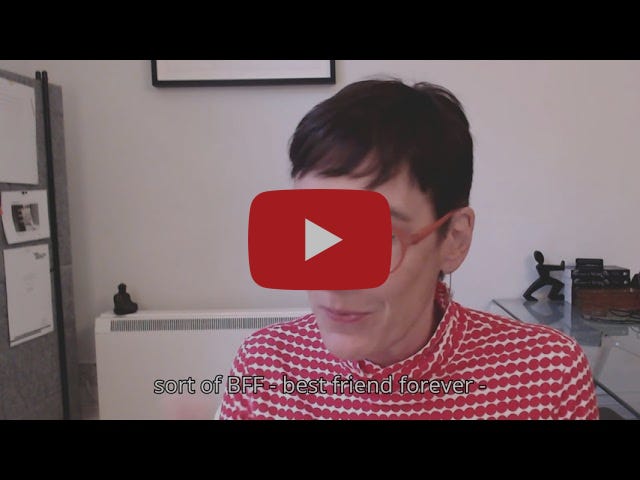
Below are three attributes required for hope and how hope (and its BFF, fear) can spur us to action.
Some wonderbringers for me this week:
Finding hope when everything feels hopeless: Hope is important for resiliency. Here are ways to boost it.
For this former refugee, voting is an act of hope: ‘Voting isn’t just a right; it’s a victory.’
Listen: In Our Time podcast: Was hope left in Pandora’s box as consolation or another evil?
Read: Hope for Cynics: The Surprising Science of Human Goodness by Jamil Zaki
For any Spanish-speaking readers (or anyone who wants to translate it), here is a recent interview I did with a Spanish periodical on why wonder at work is so important. I hope you enjoy it!
Are you a passionate voter? If so, share with me what voting means to you. And please make sure to get out and vote! I did! (See here for a pic of me voting at the US Embassy in London.)

With wonder,

Follow Me


Why am I getting this email?
Good question!
You’re getting this email because you are on HATCH Analytics’s or Monica Parker’s mailing list.
If you don’t want to receive these emails, you can unsubscribe at the bottom.
(We do hope you stick around, though.)
Copyright ©*|CURRENT_YEAR|* Monica C. Parker. All rights reserved.
Want to unsubscribe? That’s ok! We’re sad to see you go, but you’ll still be a part of our Wonderbringer community in spirit.
Mailing address:
10 Colosseum Terrace
London, UK NW1 4EB